

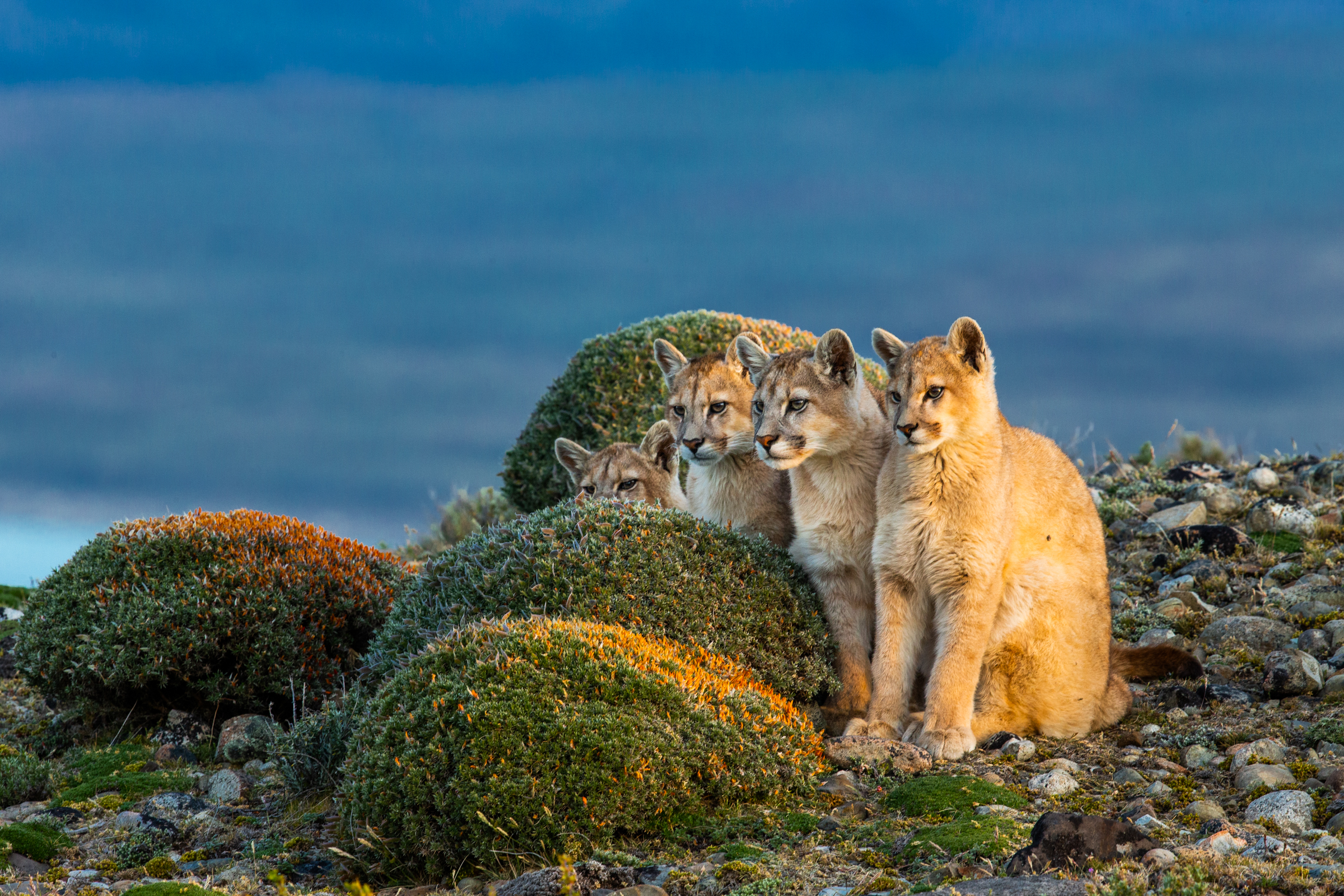
Mountain lions have a distinctive “M” shaped pad with three lobes on the rear of the heel (dogs only have two lobes). Their claw marks do not show in the track. Walking, the cat’s hind foot steps in his fore track, creating overlapping patterns. Their toes slant — similar to human feet — indicating left or right foot. Dog tracks are more symmetrical, and the raised dirt in the middle forms an “X” shape. Click here for more information on mountain lion tracks, scat and other signs.
YES! The American lion’s scientific name is Puma concolor, and is sometimes referred to as “the cat of many names.” The scientific name was changed from “Felis concolor” in recent decades. Mountain lions once ranged more extensively than any other mammal in the Western Hemisphere. Historically they could be found anywhere from the Canadian Yukon to the Straits of Magellan — over 110 degrees in latitude — and from the Atlantic seaboard to the Pacific Ocean. As a result, each native tribe and group of European explorers gave the cat a different name. Today, mountain lions are listed in dictionaries under more names than any other animal in the world. Writer Claude T. Barnes listed 18 native South American, 25 native North American, and 40 English names for the same animal. Depending on the region and native language, common names for the American lion include: mountain lion, cougar, panther, puma, painter, el leon, and catamount. To learn more about the origins of some of these names, read Chapter 1 of Cougar: The American Lion.
Although the mountain lion may have more names and nicknames than any other animal, the following are not names for lions and represent completely different species: bobcat, lynx, ocelot, jaguar, leopard, cheetah, Asiatic lion, African lion, and tiger. Many people have heard the term “black panther,” but these are actually melanistic jaguars or leopards: a genetic trait that makes an individual cat’s fur appear much darker than the usual coloration. To date there has never been a confirmed case of a melanistic (black) mountain lion.
The solitary and elusive nature of mountain lions makes them difficult to research and practically impossible to count. Population estimation models are based on numerous long-term studies of lion populations, their prey, and habitat mapping. Based on the best available data at this time, the Mountain Lion Foundation believes the mountain lion population in the United States is unlikely to exceed 30,000. And, many of those lions depend upon severely fragmented and degraded habitat, are in severe danger of over-hunting and road kill, are imperiled by intolerance of their presence on the landscape, and are so few and unconnected they are on the edge of genetic viability. People are responsible for the death of more than 3,000 mountain lions in the U.S. each and every year.
For more information, read How Many Lions are in the United States?
Puma concolor means lion of one color. Adult mountain lions have a tan-colored coat — much like the African lion — but are slighter in build with a head that is smaller in proportion to its body.
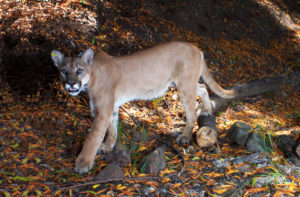
The sexes look alike, though male lions are 30 to 40 percent larger than females. Though sizes vary greatly throughout the cat’s geographic range, a typical adult male will weigh 110 to 180 pounds and the female 80 to 130 pounds. Exceptional individuals have exceeded 200 pounds, but this is rare. Adult males will measure 6 to 8 feet from nose to tail tip and females 5 to 7 feet. The most recognizable feature of the American lion is its long and heavy tail, which measures almost one-third of the lion’s total length.
Mountain lion kittens or cubs (either term is correct) have camouflaging spots and rings around their tails that fade as they mature.
For more information on mountain lions check out MLF’s Biology & Behavior page. To learn how to identify a lion’s age and gender, check out this helpful ID Guide from the Washington Department of Fish and Wildlife.
Mountain lions used to occupy the entire United States coast-to-coast, but today they are primarily found in 14 western states with a small endangered population in Florida. Five very small populations have regained an unsteady foothold just east of the Rockies in the 1980s and 90s, but their future is uncertain.
They prefer areas with dense undergrowth and cover, and will leave an area if they perceive a threat. Found in deserts, humid coast forests, arid hillsides, scrub and oak woodlands, lions can live from sea level to snow-covered mountain peaks.
A ten year lifespan is considered old age for a mountain lion in the wild. Lions in captivity have been known to live twice that long. In areas where mountain lions are hunted for sport, only a small percentage make it past five years old.
Mountain lions are solitary unless mating or parenting and maintain territories that average 100 square miles in size. Lions mark their territories by clawing trees and urinating on scratch piles of dry leaves, grass or pine needles. They will fight other lions, even to the death, to protect their territory. A female with kittens will move to a new den site within her territory every few weeks to protect her kittens from predators and male lions. To learn more about “Cougars at Home,” check out Chapter Three of MLF’s on-line book; Cougar: The American Lion.
Opportunistic hunters, mountain lions typically hunt alone from dusk to dawn, taking their prey (primarily deer) from behind. On average, a lion will kill a deer about once a week. They also dine on coyotes, raccoons, rodents, elk, feral hogs, and even porcupines. They may drag the meal to another area and cover it with dry leaves, grass or pine needles to protect the food from other animals and to reduce spoilage. A mountain lion may return to feed at the site over a period of several days. For more information on a lion’s diet, read Chapter Four of MLF’s on-line book; Cougar: The American Lion.
To deer, yes! To people, not so much. Human encounters with mountain lions are rare and the risk of an attack is infinitely small. You are more likely to drown in your bathtub, be killed by a pet dog, or hit by lightning. If lions had any natural urge to hunt people, there would be attacks every single day. Instead, they avoid us.
But if you live, work, or play in cat country, be alert! Avoid walking alone between dusk and dawn when lions are most active. Keep your children and pets close to you. Never approach or corner a mountain lion (or any wild animal). If you do encounter a mountain lion, STOP. DO NOT RUN. Unlike safety advice for encountering bears, do not act timid or play dead in front of a cat.
Instead: Maintain eye contact. Stand tall. Look bigger by opening your coat or raising your arms. Slowly wave your arms and speak firmly. Throw items at the lion if necessary. Give the cat room and time to move on.
In the rare event of an attack, fight back. Most people succeed in driving the mountain lion away.
If you live in or around mountain lion habitat, it is wise to bring your animals indoors at night. Although still a fairly rare occurrence, domestic animals can be an easy meal for mountain lions and other wild predators. Mountain lions hunt primarily at night and unprotected pets, sheep and goats are easy prey. Most pets and livestock do not have the skills to protect themselves and are dependent on people for their safety. The threat to domestic animals from mountain lions can easily be avoided by modifying animal husbandry practices. See MLF’s 4 Simple Steps for more details.
No. The assertion that sport hunting is a necessary and effective strategy for reducing mountain lion attacks on people remains widespread in the mainstream media and in the popular literature. While some state wildlife agencies, such as in California and Wyoming, state that sport hunting cannot be expected to increase public safety, other state agencies have claimed the opposite, apparently to garner public support for sport hunting. For example, without any scientific research to back their theory, in 2005 the South Dakota Game, Fish and Parks offered as the primary justification for their state’s first-ever sport hunting season on mountain lions that it “may be a more effective solution [than removal of individual lions] for dealing with problems caused by mountain lions.” This would be like the police department saying their new plan to reduce crime is to start randomly arresting innocent people on the street.
Annually killing off thousands of lions in wilderness areas that avoid people does not make the remaining lion population fearful of humans.
An overwhelming number of studies have clearly demonstrated that sport hunting of lions not only does not increase the public’s safety, it also does not reduce depredation on livestock or other domestic animals, and in fact appears to be responsible for the increase in human/lion conflicts in regions where lion mortality is excessive. For more information see Effects of Sport Hunting on Cougar Population, Community and Landscape Ecology and the latest research on what happens when adult lions are excessively hunted: Troubled Teens.
Although many people believe the number of lions in the U.S. is increasing, this is not the case. Habitat destruction, roadkill, poaching, poisoning and primarily trophy hunters are killing more mountain lions today than at any other time in our nation’s history. More lions are being shot today by hunters than were killed during America’s bounty period when residents were paid for helping eliminate unwanted species; and quotas continue to be increased every single year. There is no legitimate reason to trophy hunt mountain lions: it is purely a recreational sport. MLF and our supporters around the globe believe it is time for this brutal and outdated pastime to come to an end. It is no longer in line with society’s views and our remaining wildlands cannot endure the slaughter of this apex species.

Wildlife biologists know mountain lions are vital and invaluable. It is a keystone species playing an irreplaceable and complex role on the landscape. Lions exist in low densities and are self-regulating which means they control their own population size in balance with the ecosystem without the need for human intervention. Top carnivores help maintain the plants and animals within their range. Mountain lions keep deer herds on the move so that they do not overgraze in any particular area. This behavioral change results in less erosion along riverbanks and increases habitat for other species like songbirds. Ecosystems with lions are healthier, more sustainable, and contain a richer balance of nature.
Because they are so difficult to research, we don’t know how many are left, only that we are making it increasingly difficult for lions to find suitable habitat and avoid hunters. If the species is to survive, or stand a chance at recolonizing the eastern two-thirds of our country, effective protection laws need to be put in place now. To find out more about the threats facing mountain lions in America today, visit MLF’s Threats page.
Founded in 1986 to stop the trophy hunting of mountain lions in California, the Mountain Lion Foundation (MLF) has grown into a national, non-profit conservation and education organization dedicated to protecting mountain lions and their habitat. MLF has inspired citizens across the nation to act on behalf of lions and their habitat by presenting practical solutions to complex problems, providing unbiased information to media, aiding local activists, promoting lion research, influencing regulation and changing laws.
Your membership, at any level, makes you part of a nationwide network of individuals who commit dollars and energy to the cause of Saving America’s Lion. For more information on who we are and what we have accomplished visit MLF’s About page.
If you still cannot find what you are looking for please contact us and we will try to assist you in finding what you are looking for on the MLF website. Our email is info@mountainlion.org, and our phone number is 916-442-2666.